
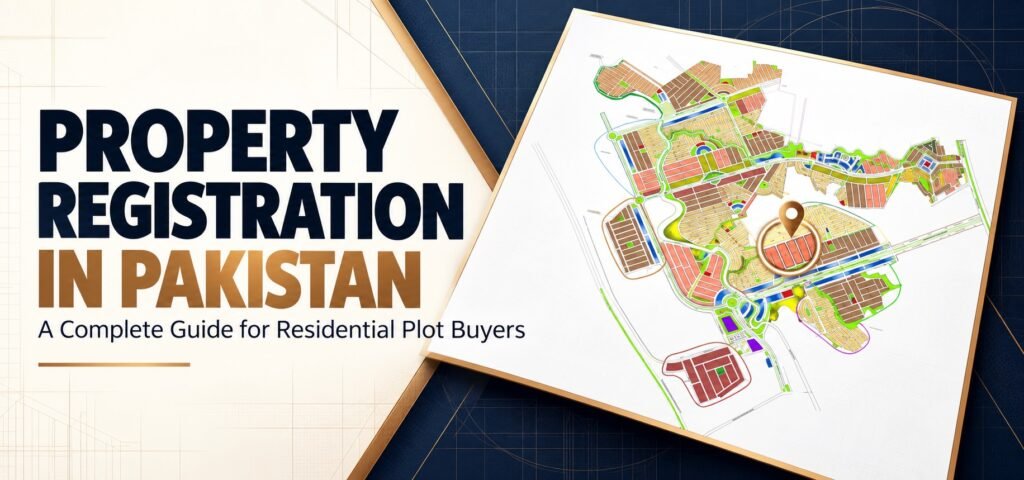
A complete guide to property registration in Pakistan for residential plot buyers, documents, process, fees, and mistakes to avoid before you register.
Buying a residential plot is a major financial decision, but the purchase itself is only half the process. Until a buyer completes property registration, ownership is not fully secured in the eyes of the law. Many first-time buyers in Pakistan assume that signing a sale agreement and paying the seller is enough, only to discover later that their plot register entry was never updated, or that a dispute has surfaced because someone else’s name still appears on record.
This guide walks residential plot buyers through what property registration actually means in Pakistan, why it matters, what documents are required, how the process works step by step, and the common mistakes that create legal and financial headaches later. Whether you’re buying your first plot or adding to an existing portfolio, understanding plot registration protects your investment long before construction ever begins.
For most buyers, the confusion comes from the fact that property registration in Pakistan involves more than one authority and more than one record. A plot can look fully “yours” on paper, while the underlying government record still shows the previous owner. This guide is written to close that gap.
Property registration is the legal process of recording a change of ownership with the relevant government authority, so that the buyer’s name is officially entered into the property register. In Pakistan, this typically involves the local Sub-Registrar’s office, the Land Revenue Department (Patwari and Tehsildar), or, in the case of housing societies, the society’s own transfer and registration department working alongside these government bodies.
Without proper registration, a buyer’s claim to a plot rests only on a private agreement between two parties. That agreement may be valid between buyer and seller, but it does very little to protect the buyer against third-party claims, double-selling, or inheritance disputes involving the original owner. A registered property, on the other hand, becomes part of the public record, meaning the buyer’s ownership can be verified, defended, and passed on without ambiguity.
A registered property gives the buyer standing in court if ownership is ever challenged, since the government record itself becomes evidence of legitimate transfer.
Registration produces an official document, commonly relied upon for mortgages, resale, inheritance planning, and future transactions.
Because registration updates the public record, it closes the door on a seller trying to sell the same plot to more than one buyer.
Banks, housing societies, and future buyers will almost always ask to see registration documents before proceeding with any transaction involving the plot.
Not every property transaction in Pakistan is documented the same way, and buyers should understand the difference before assuming their plot is registered.
| Registration Type | What It Confirms | Where It’s Recorded |
| Sale Deed Registration | Formal transfer of ownership from seller to buyer | Sub-Registrar’s Office |
| Mutation (Intiqal) | Update of ownership in revenue records | Land Revenue Department |
| Society Transfer | Internal ownership update within a housing society | Housing Society Records Office |
| Fard-e-Malkiat Update | Reflects current ownership on the record of rights | Patwari / Revenue Office |
For plots within an organised housing society, buyers usually need both the government-level registration and the society’s own internal transfer process to be completed, since the two systems are not always automatically linked.
It helps to think of these as layers rather than alternatives: sale deed registration establishes the legal transfer, mutation updates the government’s own revenue record, and society transfer keeps the developer’s internal records consistent with both. A buyer who completes only one layer, assuming the others follow automatically, is the most common source of ownership disputes years later.
Before starting the registration process, buyers should gather the required paperwork. Missing or incomplete documents are one of the most common reasons registration gets delayed.
Buyers purchasing from overseas should confirm early whether their power of attorney needs to be attested by a Pakistani embassy or consulate, since this step is often overlooked and can delay the entire registration timeline by weeks.
It’s worth preparing two sets of every document from the outset, one for the Sub-Registrar’s office and one for the housing society’s transfer department, since offices rarely return originals on the spot and a missing copy often means a second trip.
Before registration begins, confirm that the seller’s title is clean, meaning there are no outstanding loans, disputes, or competing claims against the plot. This is typically done by obtaining a Fard (record of rights) from the relevant revenue office.
A sale deed is prepared, outlining the agreed price, property description, and terms of transfer. Both parties sign the deed, usually in the presence of witnesses.
Stamp duty, registration fee, and any applicable withholding tax must be paid before the deed can be formally registered. These amounts vary by province and are usually calculated as a percentage of the declared property value.
The sale deed, along with supporting documents, is submitted to the Sub-Registrar’s office for verification and formal registration.
Both buyer and seller are generally required to appear in person for biometric verification, confirming identity before the deed is officially registered.
Once the sale deed is registered, the buyer must apply for mutation (Intiqal) so that the property register at the revenue department reflects the new owner’s name.
For plots in a housing society, the buyer should also complete the society’s internal transfer process, ensuring membership and utility records are updated to reflect the new ownership.
Registration costs in Pakistan generally fall into a few categories, though exact rates depend on the province and the declared value of the property.
Buyers should always request an official fee breakdown from the relevant office or their property consultant rather than relying on estimates, since these rates are periodically revised.
A signed agreement between buyer and seller is not a substitute for formal registration. Without registration, the buyer’s legal protection remains limited.
Buyers sometimes proceed to registration without confirming that the seller’s title is free of disputes, loans, or competing claims, only discovering problems after the transaction is complete.
Even after government registration, failing to complete the housing society’s internal transfer can create confusion around utility bills, membership records, and future resale.
Registration involving mutation and society transfer can take several weeks. Buyers who assume it will be completed in a single visit often face avoidable frustration.
Every document submitted during registration should be copied and retained by the buyer, since originals are sometimes required again for future transactions.
Even when a plot is purchased through a well-known dealer or a reputable housing society, buyers should independently verify the title. A trustworthy dealer speeds up the process, but does not replace the buyer’s own due diligence.
Some buyers take possession of a plot and postpone formal registration, planning to complete it “later.” Delays create risk, since the seller’s circumstances can change in ways that complicate registration if it isn’t finalised promptly.
Buyers sometimes confuse taking possession of a plot with completing its registration. Possession means the buyer has physical access to and use of the property, while registration means ownership has been formally recorded. It is entirely possible to have possession without registration, which is precisely the situation that creates long-term legal risk. A buyer aiming for full legal security should treat possession and registration as two separate milestones.
Buyers purchasing plots in planned housing societies often assume that because the developer manages internal records, formal government registration is optional. This is a mistake. Society records exist to manage internal allotments and transfers, but they do not replace the legal weight of a properly registered sale deed and updated mutation record. A buyer who wants a plot that can be mortgaged, resold, or passed on through inheritance without dispute needs both layers of documentation in place.
Before treating a plot purchase as finished, buyers should be able to confirm each of the following:
Working through this list methodically, rather than assuming each step will happen automatically once the previous one is done, is what separates a smooth registration process from one that drags on for months.
Completing property registration is not a formality to handle after the fact; it is the step that turns a purchase agreement into legally recognised ownership. From verifying the seller’s title to completing plot registration with the Sub-Registrar and updating the property register through mutation, each stage protects the buyer against disputes, fraud, and complications down the road.
For buyers evaluating residential plots in a planned community, choosing a housing society with transparent documentation and a structured transfer process makes the entire registration journey considerably smoother. Kohistan Enclave offers residential plots across multiple blocks, supported by clear allotment and transfer documentation designed to help buyers move confidently from purchase to full legal ownership.
Kohistan Enclave, Grand Trunk Rd, Wah, Rawalpindi, Punjab
info@kohistanenclave.com
© 2026 Kohistan Enclave- All Right Reserved Kohistan Enclave
Design & Developed by KBD